Everyone driving between Ottawa and Toronto faces the same fork: the 401’s four lanes of certainty, or Highway 7’s two lanes of actual Ontario. Here’s the honest math, without romance.
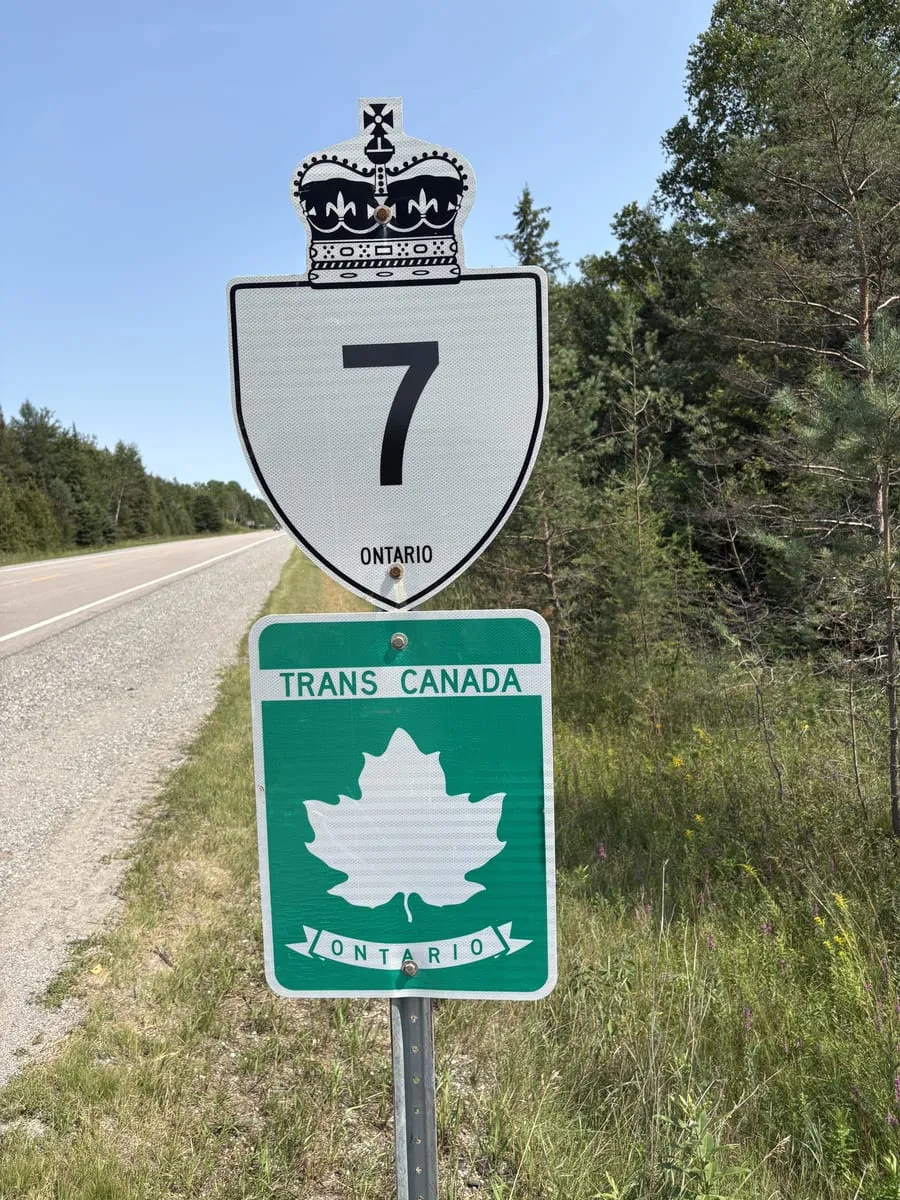
The raw numbers
We routed both ways, downtown to downtown, with the open-source route planner OSRM in October 2026.
| Trip | Via Highway 7 | Via the 401 | What the 7 costs you |
|---|---|---|---|
| Ottawa to Toronto | 404 km | 451 km (by the 416) | About 35 minutes more, for 47 fewer kilometres |
| Ottawa to Peterborough | 272 km | 375 km (by Kingston) | Nothing. The 7 is the fast way, by about 30 minutes |
Two things stand out. For Toronto, the 401 wins on time by roughly half an hour in free-flowing traffic, and any Highway 7 site that tells you otherwise is selling something. For Peterborough and the Kawarthas, there’s no contest at all: the 7 is shorter by a hundred kilometres and quicker, which is why every route planner sends you this way anyway.
Those are differences in free-flowing traffic. We quote the gap rather than the total because route planners disagree on totals, and your own right foot disagrees with all of them.
When the 7 wins on time
- Friday summer afternoons, when the 401 through the east end of the GTA is a parking lot and the 7 just isn’t.
- Long weekends, same story, both directions.
- A 401 incident. One closed lane near Port Hope or Belleville wipes out the half hour on its own. Check before you choose: our Drive It page carries what Ontario 511 is reporting on the 7 right now.
The break-even
On the Toronto run the 7 is 47 km shorter, so it burns roughly four litres less fuel in a typical car. The time is the real cost, and it’s about the length of one good stop. Spend it on any one of these and the drive has paid for itself:
| km from Ottawa | Stop | What the half hour buys |
|---|---|---|
| 50 | Carleton Place | The corridor’s on-ramp, on the Mississippi River |
| 85 | Perth | Lunch on the Tay Basin, in the stone heart of the corridor |
| 105 | Maberly | A swim at Silver Lake Provincial Park’s beach, right on the highway |
| 120 | Sharbot Lake | The midpoint: two lakes and the rail-trail junction |
| 150 | Kaladar | The crossroads, and the turn north to Bon Echo |
| 190 | Madoc | A proper bakery-and-diner stop |
| 205 | Marmora | The mine lookout, the corridor’s most underrated five minutes |
| 270 | Peterborough | The Lift Lock, and the Kawarthas beyond |
Or let the guides pick for you: a chip truck from the census, a beach or swimming hole, a stretch of trail. If anyone in the car is under ten or over sixty, the stops stop being a delay and become the whole reason for the trip.
Charging an EV
Both roads work. The 7 has fast chargers in Carleton Place, Perth, Madoc, Norwood and Peterborough, with Tesla Superchargers at Perth, Madoc and Peterborough. The longest gap is Perth to Madoc, about 105 km through the lakes. The 401 has more of them, closer together, at the ONroute stops near Napanee and Kingston. Both lists, and every charger along the 7, are on our Drive It page.
When to take the 401 without guilt
Night driving (the 7 is dark and moose country), winter squall days, and any trip where you’re genuinely racing a clock. Our Drive It page carries Environment Canada’s warnings for the corridor, so you can make the call before you leave. The slow road is a choice, never a penance.