Nine ceremonies between Carleton Place and Peterborough, each organized by its own
Legion branch or municipality, not by us. Every town listed below gathers at the 11th hour
of the 11th day of the 11th month. We've verified each event using the relevant Legion
branch's or municipality's own website, or a local newspaper's coverage.
11:00amThe moment of silence, the 11th hour of the 11th day of the 11th month
9 ceremoniesAlong the corridor, Carleton Place to Peterborough, each sourced to its branch or town
220 kmCarleton Place to Peterborough. There's a cenotaph on nearly every stretch of it.
108 yearsSince the Armistice of November 11, 1918
“They shall grow not old, as we that are left grow old: age shall not weary them, nor the
years condemn. At the going down of the sun and in the morning, we will remember them.”
— Laurence Binyon, For the Fallen, 1914, recited at Legion services across the corridor every November 11
November 11
Every ceremony, east to west
Most of the towns below run a parade first. Colours, cadets, Legion members, and
sometimes a pipe band form up twenty to forty minutes ahead of the service, usually at
the Legion, and march to the cenotaph for the moment of silence. Each card says where
and when. Showing up at 11 sharp means missing the march.
And the cenotaph usually isn't at the Legion hall itself. Carleton Place's and Smiths
Falls' both sit in a Veterans Memorial Park. Perth's stands in front of the hospital.
Peterborough's sits in Confederation Square downtown. So the address below is the
cenotaph, not the clubhouse.
Hosted by the Perth-Upon-Tay Royal Canadian Legion Branch 244 at the cenotaph in front of the Great War Memorial Hospital, itself built as Perth's First World War memorial.
Hosted by Royal Canadian Legion Branch 389, with refreshments at the Legion after the ceremony.
Parade lineup at the Legion, 10:30am; cenotaph ceremony and wreath-laying at 11am; reception follows at the Legion Havelock Cenotaph, 39 George St E, Havelock, ON
Hosted by Royal Canadian Legion Branch 300. A march of the colours, wreath bearers and Legion members to the cenotaph for the 11th-hour service. Call the branch at 705-639-2374 with questions.
Organized and hosted by Royal Canadian Legion Branch 52. The parade goes south on George, east on Hunter, north on Water and west on McDonnel, then back to the Memorial for the service. To lay a wreath, order one from the branch at 705-745-6361.
10am to about 11:20am Citizens' War Memorial, Confederation Square, 499 George St N, Peterborough, ON
The Royal Canadian Legion's Poppy Campaign runs from October 24 to November 11, with those
dates fixed from this year onward. Donations go to the Legion's Poppy Trust Fund, which
supports veterans and their families.
More from the Legion
What you'll hear at eleven
The Last Post's final note begins the silence. The Rouse ends it.
The Last PostThe bugle call that once closed the soldier's day, played for the dead
Two minutes of silence11:00am, the 11th hour of the 11th day of the 11th month
2:00
The RouseThe bugle call that ends the silence
The LamentFlowers of the Forest, on the pipes, where a piper is part of the service
Recordings by the Canadian Armed Forces, from
Music for commemorative ceremonies
on canada.ca. Reproduced here for non-commercial use; not the official version, and not
endorsed by the Government of Canada.
“In Flanders fields the poppies blow / Between the crosses, row on row, / That mark our
place; and in the sky / The larks, still bravely singing, fly / Scarce heard amid the guns
below.”
— Lieutenant-Colonel John McCrae, In Flanders Fields, written near Ypres, 1915
All year
Remembered along the 7
They grew up along this road. Some are named on its cenotaphs; some came home. Town by
town, east to west, here are a few of their stories and the memorials their neighbours
keep.
Born in Carleton Place in December 1893, Roy Brown learned to fly at the Wright School of Aviation in Dayton, Ohio, because the Royal Naval Air Service wanted a pilot's licence before it would take him. He flew with No. 9 Naval Squadron and won the Distinguished Service Cross in 1917.
On April 21, 1918 Manfred von Richthofen, the Red Baron, was chasing Brown's friend Wop May when Brown dove on him and fired, and Richthofen went down. Who fired the fatal shot is still argued over: Australian machine gunners on the ground claimed it, and Canada's Aviation Hall of Fame says it wasn't Brown. Carleton Place's Legion, Branch 192, is the Captain A. Roy Brown Branch.
Elton Megert was the son of Jacob Megert of Smiths Falls and the late Mary Megert. A private in the 38th Battalion, he was killed on April 9, 1917, the first day of the Battle of Vimy Ridge, at 20. He has no known grave, and his name is on the Vimy Memorial in France.
For Vimy's hundredth anniversary, a Grade 10 history class at Smiths Falls District Collegiate researched the town's men who served there, and his service record was the one their teacher put up on the screen to show them how to start. Some records spell his name Megart.
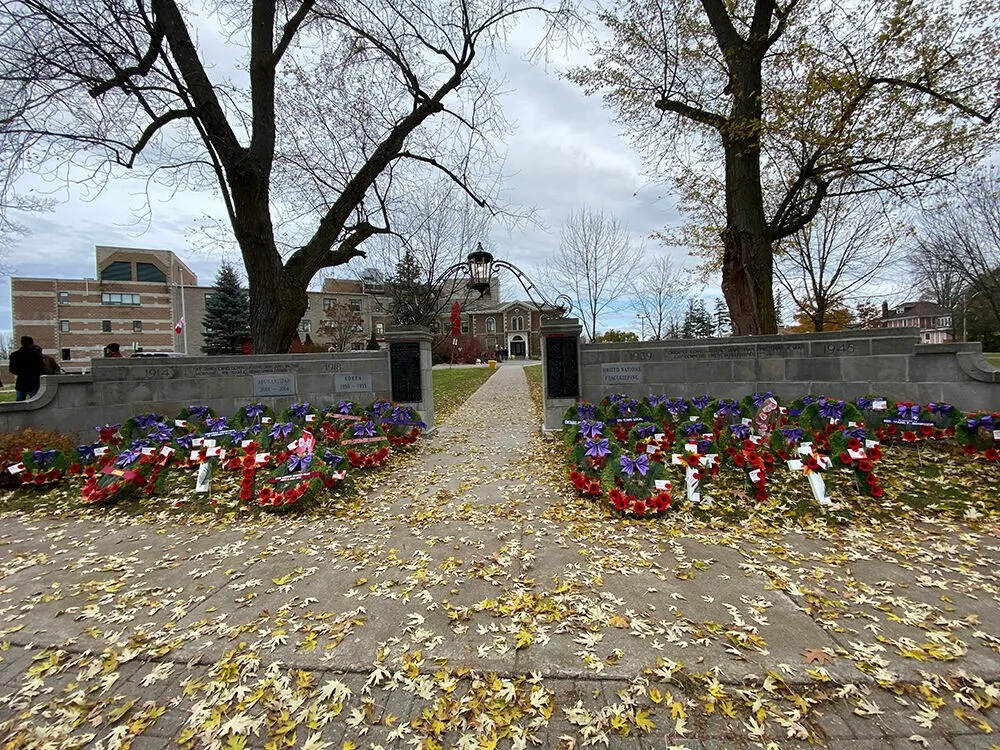
Perth · km 85 The Perth cenotaph, the Great War Memorial Hospital behind it. Photo: Inside Ottawa Valley News
John Andrew Hope and the Great War Memorial Hospital
Perth built its First World War memorial as a hospital, and the cenotaph stands at its front gates on Drummond Street West. Branch 244's service is there at 10:45am on November 11, and by the end of the morning the wreaths run the length of both walls.
The man behind it was John Andrew Hope, who came home wounded twice, at Passchendaele and at Drocourt-Quéant, and decorated for gallantry at Lens and Amiens. As president of Perth's Great War Veterans' Association he led the push that turned Victoria Hall into a 20-bed hospital, and in 1923, with nearly 2,000 people standing in the rain, he opened the Great War Memorial Hospital. He went on to sit on Ontario's Court of Appeal. The Ontario Heritage Trust unveiled a plaque to him at the hospital in September 2026.
Edward Badour enlisted at Sharbot Lake in 1916, at 32, and reached France with the 20th Battalion in March 1917. At Passchendaele he was wounded and taken prisoner on November 10, 1917, and he died of his wounds a week later. He has no known grave.
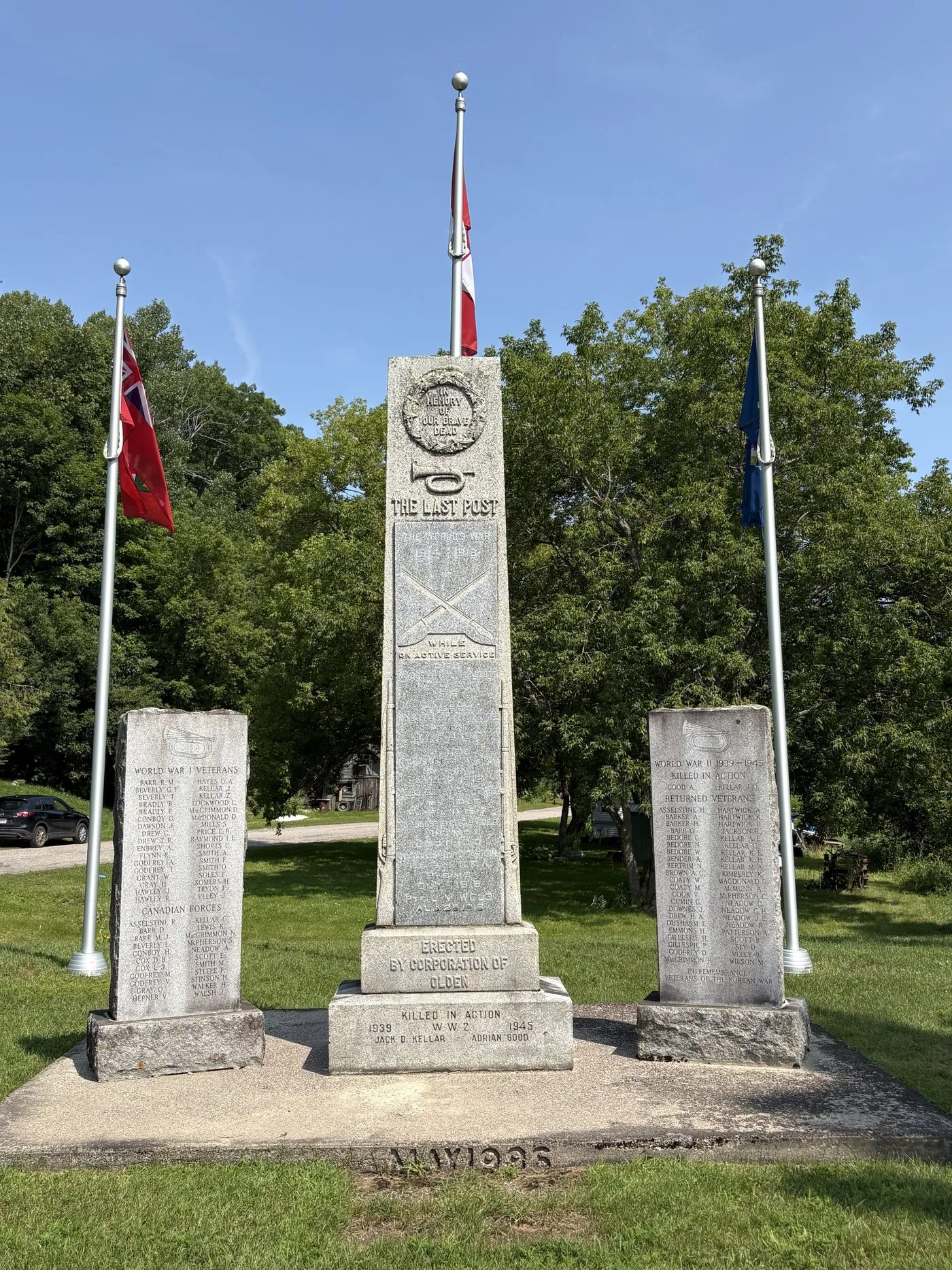
Mountain Grove · km 133 The Olden war memorial, Mountain Grove, August 2026
Jack D. Kellar and Adrian Good, on the Olden memorial
Three minutes south of the highway, west of Sharbot Lake, in the old township of Olden: a column, a bugle, and more names than a village that size looks like it should carry. Mountain Grove doesn't have a confirmed ceremony of its own, but the memorial is real, and it's ours. Two men from here, Jack D. Kellar and Adrian Good, were killed in action in the Second World War, and their names are cut into the base of the column the Corporation of Olden put up.
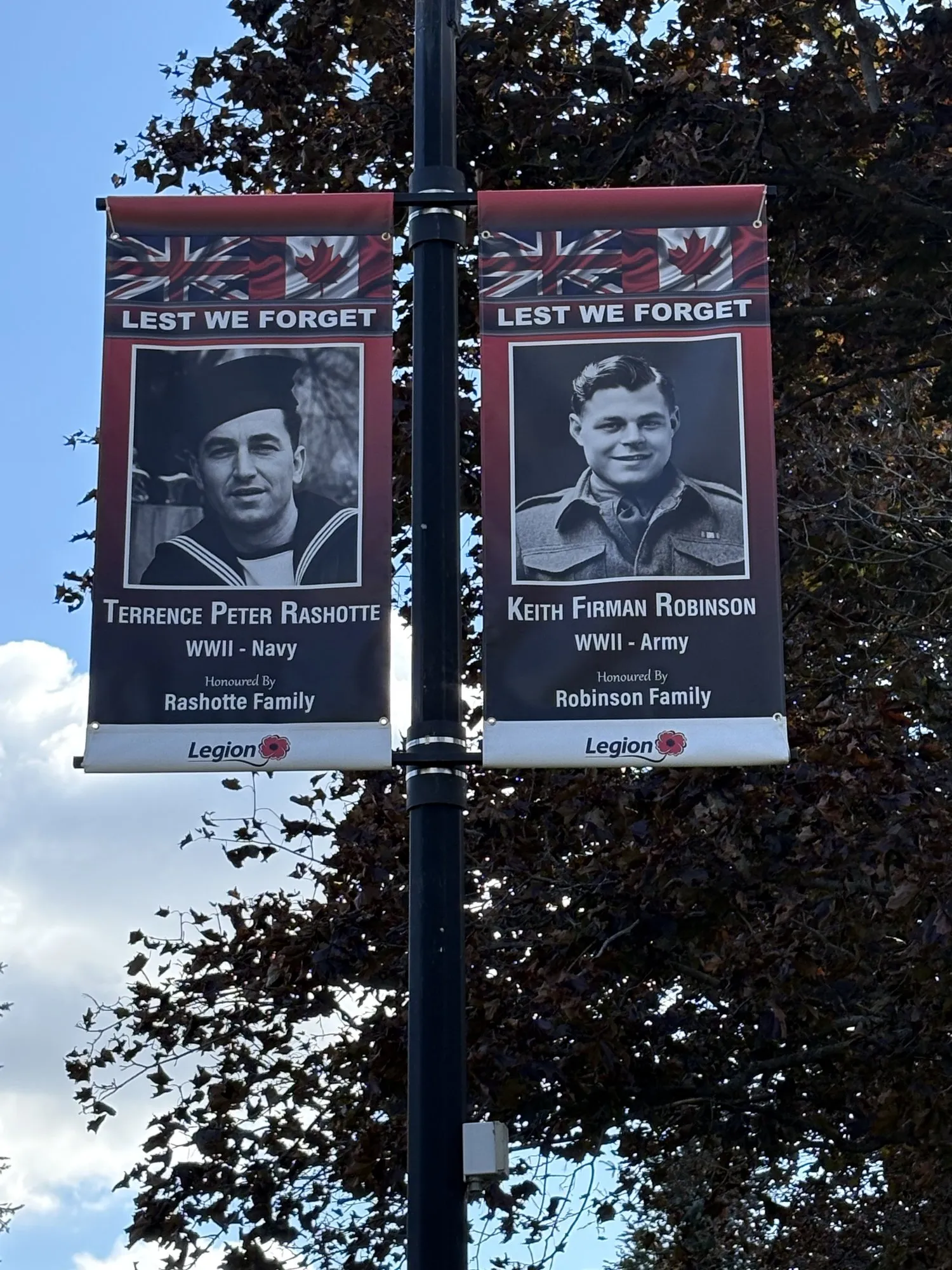
Tweed · km 165 Legion banners at Tweed Memorial Park, September 2026
Rashotte, Robinson and Holmes: the Tweed banners
Walk through Tweed Memorial Park this fall and the lamp posts have faces on them: Legion "Lest We Forget" banners, each with one local veteran's photograph, name and service, and the family who put it up. Terrence Peter Rashotte, Navy. Keith Firman Robinson, Army. Morley Clayton Holmes and Elmer Holmes, a pole of their own.
Born in Madoc in 1904, John Foote was a Presbyterian minister who joined the Canadian Chaplain Service when the war began. At Dieppe on August 19, 1942, as chaplain to the Royal Hamilton Light Infantry, he spent about eight hours on the open beach under fire, carrying wounded men to the aid post and treating them there.
When the boats came to take men off, he refused his last chance to leave, chose to stay with those left behind, and went into captivity with them. His was the first Victoria Cross ever awarded to a Canadian chaplain.
Madoc's own cenotaph, in Thomas Thompson Memorial Park on St. Lawrence Street East, was put up by the Madoc Women's Institute and unveiled with full military honours in November 1928. It names the battles where the village's men fell in the First World War: the Somme, Festubert, Vimy Ridge and Passchendaele.
Born in Marmora on September 23, 1894, Alexander McFarlane enlisted in the village in March 1917 and was with the 21st Battalion by the time it moved up to Passchendaele. He was posted missing there on November 9, 1917. His body was never recovered, and his name is on the Menin Gate at Ypres.
Harry Brown was born in Gananoque in 1898 into a Peterborough family: his father, a brass moulder, was born in Peterborough and died while Harry was a boy. With the 10th Battalion at Hill 70 on August 16, 1917, he carried an urgent message back through a heavy barrage after his arm was shattered, and delivered it.
He died at the dressing station a few hours later. He was 19, and was awarded the Victoria Cross after his death.
On the 7 is an independent guide to Highway 7 and is not affiliated with, endorsed by, or
sponsored by the Royal Canadian Legion or any branch, township or municipality named above.
Every ceremony's time, address and organizing branch is cited on its own event page, sourced
to that branch's, municipality's or a local newsroom's own page as we found it.